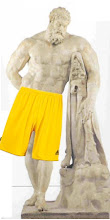
He uses the analogy of how a block of marble might be veined in such a way as to have a sculpture of Hercules ready to be shaped from it, whereas a neutral block without the veins could produce anything. He says that 'This is how ideas and truths are innate in us - as inclinations, dispositions, tendencies, or natural potentialities'.
Showing posts with label innatism. Show all posts
Showing posts with label innatism. Show all posts
Sunday, November 16, 2008
Leibniz, Innate ideas, Marble & Hercules
We read a very important extract from the preface to Leibniz's 'New Essays on Understanding' in which he responds to Locke's rejection of innate ideas. Leibniz believes that Although the senses are 'necessary for all our actual knowledge, they aren’t sufficient to provide it all.' He doesn't think that experience alone is enough to explain the way we able to understand the world and believes that 'we must be contributing something from our side' By this he means we must have certain abilities or at least potential abilities built into us when we are born.

Wednesday, October 8, 2008
More on Locke's innate ideas
We ought to record, so we don't forget, that we saw that Locke had several arguments against the notion of innate ideas and they went something like this:
1. If any idea were innate in all human minds then surely certain ideas would be universally accepted and agreed on. But they're not.
2. It makes no sense to speak of an idea being in our minds without us being aware of it. How can we have 'understandings' that we don't understand. Surely the whole point of an idea is that it is 'had'. (As in, "I've just had an idea!" said Clive.)
3. The argument that we only come to knowledge of these 'innate' ideas when we develop our 'reason', is again non-sensical and seems circular' according to Locke. (And Sam.) Because in order to know innate ideas we have to have reason, but the evidence that we have 'reason' is our knowledge of innate ideas.
Subscribe to:
Posts (Atom)








.jpg)