Wittgenstein asks us to imagine that everybody has a matchbox with a beetle in it (init?). No-one can see inside anybody else's box, but we all agree that what's in the box is 'beetle'. The point is that it doesn't actually matter what's in the box, we could all have different things, or nothing at all, as long as we 'play' the language game referring to the things in the boxes as 'beetle' it doesn't matter. The meaning of the word exists in the 'language use' about the things in the boxes; the meaning is dependent on this community of language users. The meaning of the word does not depend on what's in the box, but on the language use in which it is referred to. The meaning is not in the 'label' that the mind attaches to the sense impression, it is in the 'negotiation' and interaction with other language users that the meaning comes about.
This is most relevant for us because it sheds light on the empiricist idea that words name sense impressions that are 'sealed' inside the heads of individual observers, hidden away from everyone else just like the beetles. Because we cannot share the sense impressions, but we clearly share meaning, the meaning must be outside our heads in the use of language within our language community. The notion that we all name the same ideas inside our heads - the notion that all our beetles just happen to be identical is clearly absurd. (well, when I say 'clearly' ...) Nigel Warburton in his excellent book Philosophy the Classics describes it like this;
I have privileged access to the contents of my own mind that does not extend to the contents of yours. It is as if I have special access to a private cinema in which my thoughts and feelings are displayed; no one else has any idea of what happens within my private cinema. My experience is private to me, and yours to you. No one can really know my pain or my thoughts. I can describe my inner experience to myself, and no one else is able to judge whether or not my descriptions are accurate.
Once you have fully grasped the notion of ‘sense impressions’ as things that exist inside the mind then it’s not difficult to see how empiricism falls into solipsism.
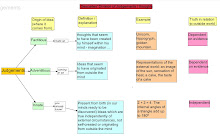
Be certain you really get what is implied when Hume says,‘The mind never has anything present to it except the perceptions, and can’t possibly experience their connection with objects.’ Although Hume has little in common with him, it might be useful to think of this as a little like Plato’s ‘cave’ analogy. All the prisoners had were the shadows on the wall, they could not turn their heads or leave the cave to check the status of the shadows; it would never occur to them to do so because, to them, the shadows were reality. Similarly we cannot leave our heads to check how fully sense impressions mirror reality.
Hume didn’t see this as problematic, but the kind of philosophers who want to find some objective ground, some ‘certainty’ beyond the particular circumstances of time and chance do. The kind of philosophers who want to escape the ‘cave’ and see the ‘reality’ behind the appearance, do. But Hume insists that, ‘We never really advance a step beyond ourselves, nor can conceive any kind of existence, but those perceptions, which have appeared in that narrow compass.’ For Hume, we just are inside our heads with the ideas that are ‘dimmer’ copies of the original sense impressions.
So if we are locked into our heads with our own individual sense impressions then how do we come to attach any meaning to the ‘ideas’ that the sense impressions leave us with?
PRIVATE LANGUAGE
Wittgenstein's so called 'private Language Argument' makes the point that a language that attempts to 'name' or give meaning to private sensations is impossible because it has no 'touchstone', no point of reference to keep its meaning consistent. This argument seems to rely on the very concept of 'meaning ' being almost synonymous (meaning the same thing) with 'sharing'. If it isn't then you wouldn't need a 'touchstone'.
If language is an intrinsically public phenomenon, and language sets the limits of our thoughts then the contents of our minds doesn't seem as private as we might have believed. Certainly it seems to make the notion of solipsism illogical. How can we define ourselves as solitary and locked in when the very use of the word shows us to be part of a language community.
If a private language is impossible then simply knowing a language refutes solipsism. We cannot be locked in if we are part of a language community and simply knowing a language confirms us as members of a language community.
I'm beginning to repeat myself, so I'll stop.
You should be aware that this interpretation of Wittgenstein's views is known as the 'community view' for obvious reasons, it is not the only view, but it is the one that makes the most sense to me. (And Nigel, I believe.)












.jpg)