Showing posts with label Empiricism. Show all posts

Sunday, November 9, 2008

Locke's Primary & Secondary Qualities (late final)


This is a little out of order, but it occurred to me that we (I) hadn't blogged anything about this and I should have done. (I've also pasted it into an earlier Locke note, but you might not notice it there. Or here probably.)

We saw how Locke’s views on ‘primary’ and ‘secondary’ qualities emphasise his belief in the physical world as grounding the sense data that empiricism relies on.

Locke’s famous snowball has primary qualities of ‘solidity, extension, figure and mobility’, in other words it takes up a certain round space in the world, you can see it and if it hits you, you’ll feel it! These qualities are in the snowball itself and will not vary according to the circumstances of the person experiencing it: they are what we might call (although I don’t think Locke does) objective qualities.

On the other hand the secondary qualities such as colours sounds and tastes vary as the circumstances of the person experiencing the snowball vary: the first snowball to hit you feels colder that than the fifth, the colour and sound it presents to your senses varies according to when, where and how you experience it.

So, if Locke thinks that the objects in the real world have primary qualities that are independent of observers then he is a ‘realist’. He thinks the world is, and is in a particular way.

Friday, October 24, 2008

Holland says 'Boo!' to Empiricists

We considered a 'characterisation' of empiricism by R. F. Holland from his book Against Empiricism: on Education, Epistemology, and Value, in which he alludes to three potential problems with empiricism. He believes that the empiricist account of the origin of ideas involves 'raw materials' entering the 'factory' of the mind in which they are 'processed and emerge cut and dried.' 

The notion of the 'mind 'processing' ideas seems to be beyond the explanations of empiricist theory; neither Locke nor Hume offer any detail on this 'process', but then how could they? Why would they? What does Holland want? Mmm..?

Holland also, perhaps more importantly, brings up what we might call the 'homunculus problem'. He characterises the empiricist theory of the way ideas spring from sense data as requiring a 'mind's eye' that 'surveys the products of its own efforts', as if a little man (homunculus) is required to look at the 'processed' sense impressions in order to make sense of them. This of course suggests another homunculus inside the first and so on into infinite regress. 

I think Holland is probably missing the point, but this is not the time to say why. His criticism is powerful. 

Holland also gently mocks Hume's notion of the 'pre-established harmony'  by which 'we find that our thoughts and conceptions have occurred in an order matching the order of events in the other works of nature.'  Holland is here referring to the apparent flaws in empiricist thinking that seem to lead to 'solipsism'. (See 'Solipsism' above).

Saturday, October 18, 2008

Locke: Two Sources of Ideas: Sensation & Reflection

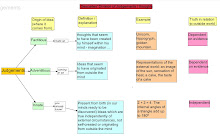
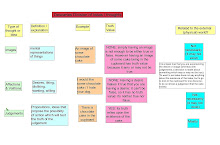
We read from 'Book 2, Chapter 1' of Locke's  'An Essay Concerning Human Understanding' and saw how he believed our minds come to be filled with ideas.  We saw that,  for Locke all ideas come from two sources: 
1. experience of 'external objects' received through our senses 
(SENSATION)
  2. experience of the workings of our own minds. 
(REFLECTION)

As he puts it: 
Our understandings derive all the materials of thinking from [1] observations that we make of external objects that can be perceived through the senses, and [2] of the internal operations of our minds, which we perceive by looking in at ourselves. 
For Locke, those are the only ways that we ideas. He says, 'These two are the fountains of knowledge, from which arise all the ideas we have or can naturally have.'
 ('Essay' Bk ii Ch.1)