Showing posts with label epistemology. Show all posts

Sunday, November 16, 2008

Stars & Pains

On Friday I asked you to try to describe or explain the difference between 
a) seeing a star
b) feeling a pain

This provoked some discussion although most of it was not entirely what I'd hoped for!  
Remember that the bit of philosophy we are doing at the moment is 'Epistemology'. We are looking at the various things various philosophers have said about how we get knowledge and the status of that knowledge. In light of that we might begin to think some useful things about this question. 

The second part of the question (we didn't get that far) should help us think some interesting things about the first part.

try to describe or explain the difference between: 
a) Seeing a star that you believe to be a hole in the floor of heaven.
b) Seeing a star that you believe to a ball of fire several million light years away.

Some thoughts/questions
  • Is it possible to make the same kind of mistake about the pain as we have about the star?
  • Would we expect the star to look the same even after our beliefs were updated? 
  • Would knowing that a pain was 'simply' the result of nerve fibres being stimulated make it 'feel' different? 
  • Is there anything different or privileged (superior) about the pain?
You won't need to answer these questions in the exam, but thinking about them might help you to a better understanding of what epistemology is all about. 

On the other hand ... just get on the with essay you haven't finished yet!
(Rorty, P&MN, p.85)


Friday, October 24, 2008

Holland says 'Boo!' to Empiricists

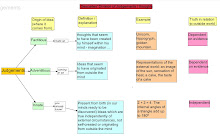
We considered a 'characterisation' of empiricism by R. F. Holland from his book Against Empiricism: on Education, Epistemology, and Value, in which he alludes to three potential problems with empiricism. He believes that the empiricist account of the origin of ideas involves 'raw materials' entering the 'factory' of the mind in which they are 'processed and emerge cut and dried.' 

The notion of the 'mind 'processing' ideas seems to be beyond the explanations of empiricist theory; neither Locke nor Hume offer any detail on this 'process', but then how could they? Why would they? What does Holland want? Mmm..?

Holland also, perhaps more importantly, brings up what we might call the 'homunculus problem'. He characterises the empiricist theory of the way ideas spring from sense data as requiring a 'mind's eye' that 'surveys the products of its own efforts', as if a little man (homunculus) is required to look at the 'processed' sense impressions in order to make sense of them. This of course suggests another homunculus inside the first and so on into infinite regress. 

I think Holland is probably missing the point, but this is not the time to say why. His criticism is powerful. 

Holland also gently mocks Hume's notion of the 'pre-established harmony'  by which 'we find that our thoughts and conceptions have occurred in an order matching the order of events in the other works of nature.'  Holland is here referring to the apparent flaws in empiricist thinking that seem to lead to 'solipsism'. (See 'Solipsism' above).

Friday, October 10, 2008

Mr Locke, Mr Scarisbrick and an introduction to Mr Hume

Today I tried to speed you up a bit. You did the following:
1. You tried to answer the very easy question, 'What is the relationship between thought and reality?'  This is what we've been trying to do all along in case you hadn't noticed. It is the question at the heart of epistemology.  The way to approach a question like this is to define your terms: what do we mean by 'relationship', 'thought' and 'reality'? 
Then think about whether there is anything anything implied by the question that might prejudice your answer? Are there assumptions built into the question? Yes. Lots of them.
Most of you had a good stab at answering it and that's the most important thing.

2. As a an anecdotal follow up to our discussion of innate ideas, I explained how Mr Scarisbrick's view of human nature informs his political stance. As mine does my own. Even though I don't think we have one. A 'human nature' that is.

3.  We read a little more of Locke on innate ideas and how he thought that experience occured in the womb. Which is interesting. Isn't it?

4.  We read some of the text book as preparation to reading some Hume, and saw how he thought that as all ideas come from experience it is possible to 'spot' pointless abstract theories by tracing their origin and seeing if they can be traced back to experience. 
His example of trying to conceive of 'a time in which nothing happens' caused some debate and confusion. and we will have to return to it, so I'll save my feeble explanations for later. 

5.  I told you about the homework which is below. 

Monday, September 8, 2008

Descartes First Meditation

We saw how Descartes used a form of extreme scepticism: he doubted everything he thougt he 'knew', even the evidence of his senses.

He gives examples of three different ways in which he may be wrong about how he perceives the world. Firstly he uses the argument from illusion; (the stick in the water) to show that his senses are not reliable. Secondly he suggests he could be dreaming: the argument from dreaming. And thirdly he considers that a malignant demon may be deceiving him deliberately about everything: the argument from deception

We also learned the meaning of ‘epistemology’, it is the study of what it is possible to know: is knowledge of the world possible, if so what?