Showing posts with label ideas. Show all posts

Saturday, October 18, 2008

Locke: Two Sources of Ideas: Sensation & Reflection

We read from 'Book 2, Chapter 1' of Locke's  'An Essay Concerning Human Understanding' and saw how he believed our minds come to be filled with ideas.  We saw that,  for Locke all ideas come from two sources: 
1. experience of 'external objects' received through our senses 
(SENSATION)
  2. experience of the workings of our own minds. 
(REFLECTION)

As he puts it: 
Our understandings derive all the materials of thinking from [1] observations that we make of external objects that can be perceived through the senses, and [2] of the internal operations of our minds, which we perceive by looking in at ourselves. 
For Locke, those are the only ways that we ideas. He says, 'These two are the fountains of knowledge, from which arise all the ideas we have or can naturally have.'
 ('Essay' Bk ii Ch.1)


Tuesday, September 30, 2008

Classification of Ideas:

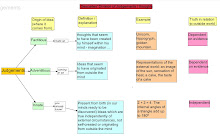
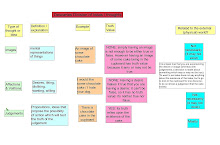
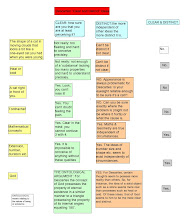
We spent some time, initially struggling, and then with the aid of my marvelous diagrams, whizzing through Descartes’ various ways of classifying various kinds of ideas. 

We saw that for Descartes, the less an idea has to with the external, physical world of the senses, the more reliable it is likely to be. So whereas an ‘idea’ or ‘image’ of a cat sat right in front of you on a sunny day will give you a ‘clear’ image (or idea) of a cat, the idea will not be ‘distinct’ because it relies on the unreliable senses. Mathematical and geometrical concepts on the other hand are both ‘clear’ and ‘distinct’ as they do not, according to Descartes, depend on ‘external’ circumstances. He goes on to try to establish the extent to which different classes of ‘idea’ depend on the external world for their ‘truth value’ and again concludes that those most independent of the physical world are the most certain. That will be maths and God again, then! (no disrespect Monsieur Descartes, but we begin to see a pattern here!) (I hope).

The Georgie Nelson Special Request Descartes' Division of Ideas Essay

How does Descartes’ ‘division of ideas’ inform his rationalist position?

▪ Explain how Descartes attempts to classify the different kinds of ideas that come into his mind

▪ Briefly (but not too briefly) explain how he does classify ideas (use your excellent charts)

▪ Explain how some ideas seem to be more 'important' than others and why that is so

▪ Explain how Descartes' conclusions about ideas make him a rationalist (explain what a rationalist is)

My introduction given free & gratis!
Having established the certainty of one idea, that he exists as a thinking thing, Descartes wonders what kind of status the other ideas in his mind might have. His exploration of a piece of wax leads him to conclude that although his senses give him a ‘clear’ idea of the wax, it is his faculty of judgement, that allows him a ‘distinct’ idea or understanding of ‘the nature of the piece of wax’.

This is homework and it is due on Monday. And that is as close to an ‘objective’ fact as I can manage! No excuses.